PIXEOS: Portable InspireX Embedded Operating System
An InspireX proof of concept for portable AV firmware. The same application source ran on Nordic and NXP microcontrollers and on a PC simulator.
Snapshot: One firmware application across two chip vendors
PIXEOS is an internal InspireX R&D project. It demonstrates how AV product teams can keep one application codebase as they move between microcontrollers.
ENGAGEMENT TYPE
InspireX R&D proof of concept
DOMAIN
Embedded systems and real-time AV firmware
DELIVERABLES
Reusable display, touch and audio components, a hardware abstraction layer, and a working audio visualiser
VALIDATION TARGETS
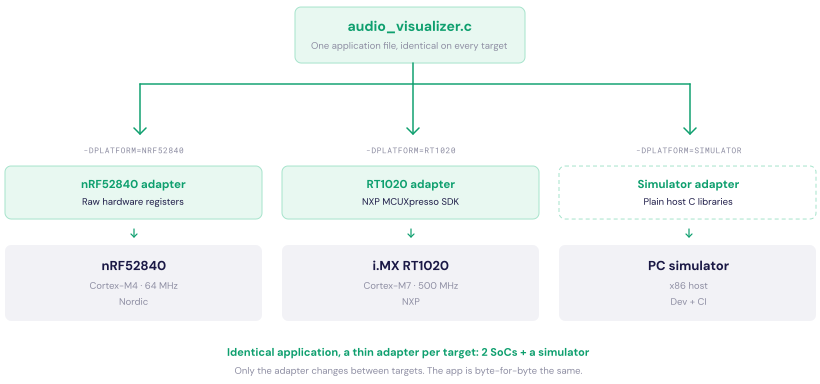
Nordic nRF52840, NXP i.MX RT1020 and an x86 PC simulator
OUTCOME
The same application source ran on two microcontrollers from different vendors and on the simulator.
{How it works}
Platform Architecture
Challenge: New hardware often means new firmware work
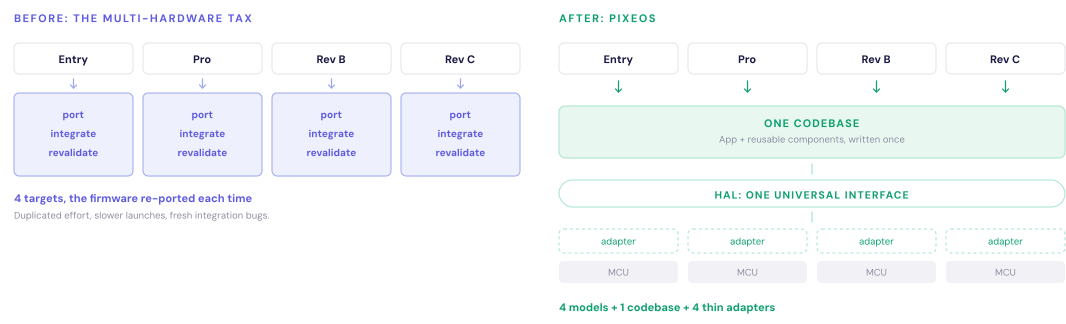
AV manufacturers may choose different chips for different models, regional variants or hardware revisions. Each change can bring a new toolchain and new work to port, integrate and retest the same product features.
Key pressure points
Chip selection changes with cost, performance and supply
End-of-life parts can force a change of vendor
Product variants can require separate firmware ports
Repeated integration and testing can delay releases
Key design constraints
Present one interface to the application across vendors and toolchains
Select the hardware backend at build time
Keep audio timing predictable on each target
Work within the memory limits of embedded hardware
Solution: One application with a thin adapter for each target
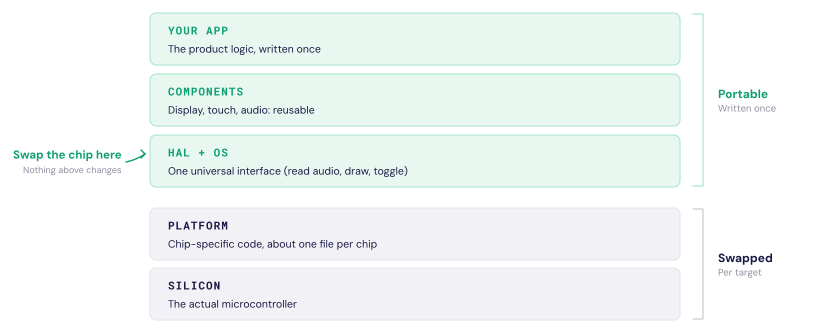
InspireX built a hardware abstraction layer (HAL), a common interface between the application and the chip. A build flag selects one adapter for each target. Both hardware builds use FreeRTOS for real-time operating system services.
APPLICATION
Reusable components The application uses the same display, touch and audio components on each target.
PLATFORM
Hardware abstraction layer Each target implements the same interface for operations such as reading audio, drawing to the display and reading a timer.
VALIDATION
Two chips and a simulator Each code push builds all three targets and runs the simulator. The team verifies device behaviour on hardware.
{The Result}
Same application source, different chips.
Results: A working AV application on two different microcontrollers
The proof of concept ran the same audio visualiser on both chips. Live audio drove the on-screen level meter, spectrum bars and sound pressure level meter. Display, touch, audio input and output, multitasking and logging worked together.
MULTI-CHIP PRODUCT LINES
Use one application codebase across supported chip vendors.
HARDWARE REFRESHES
Focus porting work on the adapter when a part reaches end of life.
PRODUCT VARIANTS
Reuse application code across entry, professional and regional models that use different hardware.
Validated Outcomes: What PIXEOS demonstrated
PIXEOS validated a firmware architecture on two unrelated microcontrollers. It gives AV product teams a tested starting point for carrying the same application code into future hardware designs.
The same application source ran on Nordic and NXP hardware and on a PC simulator.
The demo ran real-time audio, display, touch, multitasking and logging together.
Each build selected one hardware adapter through the common interface.
The team traced and fixed a hardware fault on the device during the project.
The approach applies to AV products that use multiple chips or need a hardware refresh.
{Next steps}
Validate portability on the target hardware
An AV product team can start by choosing two target chips and testing the same application against each chip’s timing, memory and peripheral requirements.
Deep dive
Technical Approach
One firmware application
▶How the same application source runs on different microcontrollers.
Hardware abstraction
▶How a common interface connects the application to each chip.
Two chips and a simulator
▶How InspireX validated the Nordic, NXP and PC targets.
Real-time audio
▶How the prototype captures audio and displays a live spectrum.
Target builds
▶How each build selects the hardware adapter for its target.
Hardware demonstration
▶What the prototype shows about portability across chips.
PIXEOS resources
Get the full PIXEOS case study
Enter your details to access the case study PDF and proof-of-concept video on one page.
Read the full architecture, testing approach and results in the PDF.
See the audio visualiser process live input on the prototype.
Get the PDF and video
Frequently Asked Questions
Common questions about the PIXEOS proof of concept.
What is PIXEOS?
Which targets did InspireX validate?
What changes when you move to another chip?
What did the hardware demo show?
How did InspireX test the builds?
Where could this approach help AV product teams?
Need a Software Partner Who Gets It?
With 15 years in the industry, we know what it takes to deliver. Let’s connect.